Triangular
Min, most likely and max are known, usually from expert estimates when there is no data.
Params: low =< mode =< high.
Category: continuous. Arrival: yes. Delay: yes. Support lower bound: 0.0. Can be fit from data as Triangular (see Input analysis).
Parameters
| Parameter | Default | Hint |
|---|---|---|
low |
0.0 |
minimum, <= mode |
high |
1.0 |
maximum, >= mode |
mode |
0.5 |
most likely value, between low and high |
Draws
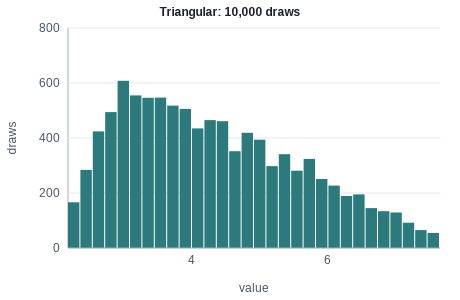
With low=2, mode=3, high=8, 10,000 draws from a stream seeded 0:
| Mean (formula) | Mean of the draws | Variance of the draws |
|---|---|---|
| 4.33 | 4.33 | 1.72 |
Example
In a model file, on any block or section that takes a duration:
{"distribution": "Triangular", "dist_params": {"low": 2, "mode": 3, "high": 8}}
In the Python builder:
nb.Triangular(low=2, mode=3, high=8)
An expression has its own call for it: TRIA(low, mode, high).
Used in
Bundled models: Belt with stops, a divert and a merge, Warehouse with forklifts (floor plan), Palletizing line, Emergency department: bedside scan (film template), Chance-based branching (DECIDE), Delay, seize/release and signal HOLD.
Guides: Python API.